Error management through different types of control and mathematical autonomy: a proposal for teacher professional development
DOI:
https://doi.org/10.46219/rechiem.v18i2.224Keywords:
Gestión del error , Modelación , Tecnología, Espacio de Trabajo Matemático, FuncionesAbstract
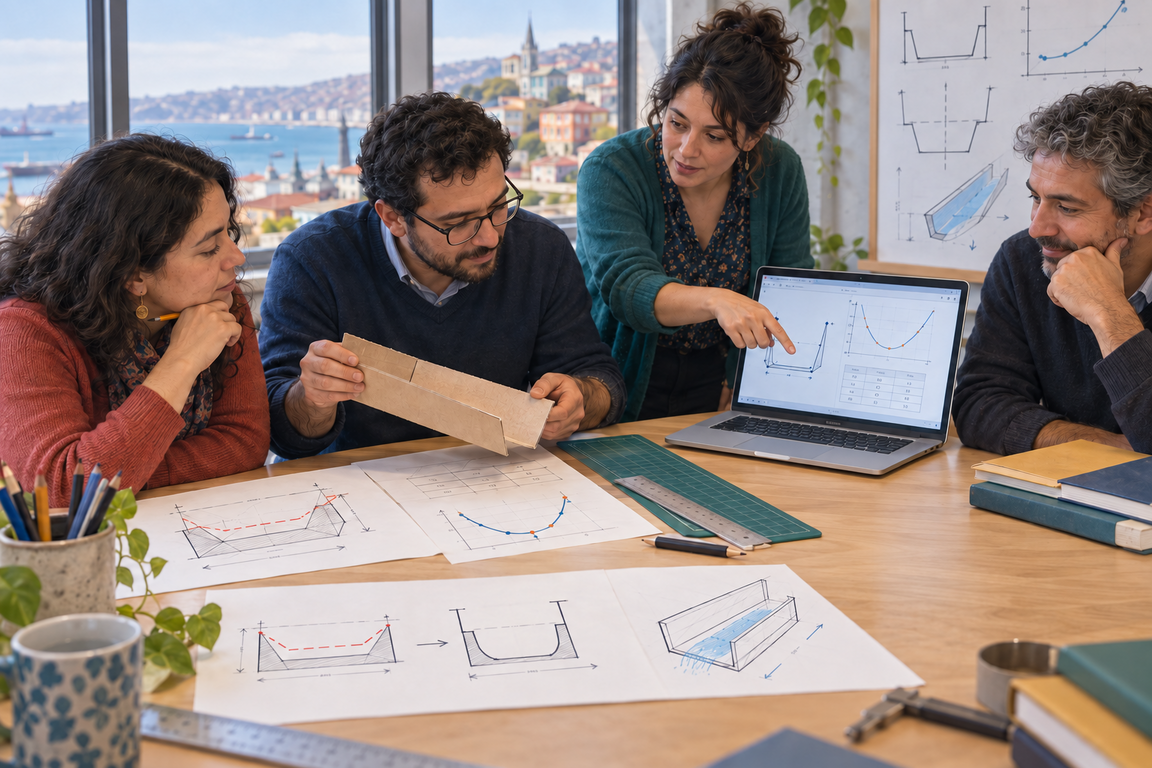
This article reports on a classroom-based experience examining how errors are managed in secondary mathematics teaching within the context of teacher professional development in Chile. In response to the low results obtained for the error-analysis indicator in the 2024 Chilean Teacher Portfolio, a workshop was conducted with teachers in the Province of Valparaíso. Through a gutter-modelling task, participants assumed the role of students and engaged with intuitive conceptions while constructing and validating a model. The notion of error control—milieu or context-based, semiotic, instrumental, and discursive— was introduced to foster learner autonomy and active learning. The findings indicate that the use of concrete materials and the digital tool GeoGebra enables learners to identify and manage errors by drawing on different registers of representation, feedback from the technological milieu, and collective reflection. Consistent with current research, it is concluded that a didactical design that anticipates errors and integrates validation mechanisms fosters a shift in teacher intervention from immediate correction towards a reflective process that promotes learner autonomy and the collective construction of knowledge.
Downloads
References
Albizu-Mallea, U., & Vera-Gajardo, A. (2025). From teaching for war to acknowledging vulnerability: a cartography of gender and mistake-handling in mathematics education. Cultural Studies of Science Education, 21, 79-101. https://doi.org/10.1007/s11422-025-10272-4
Bachelard. (1938). La formation de l’esprit scientifique. Librairie Philosophique J. Vrin.
Boomgaarden, A., Loibl, K., & Leuders, T. (2024). Fostering Learning from Errors—Computer-Based Adaptivity at the Transition Between Problem Solving and Explicit Instruction. Journal Fur Mathematik-Didaktik, 45(2), Article 9 https://doi.org/10.1007/s13138-024-00232-w
Brousseau, G. (1974). Description des 31 leçons expérimentées à l’école J. Michelet à Talence : l’enseignement des probabilités et les statistiques. IREM de Bordeaux
Brousseau, G. (1976). Les obstacles épistémologiques et la didactique des mathématiques. Comptes Rendus de La XXVIIIe Rencontre Organisée Par La Commission Internationale Pour l’Etude et l’Amélioration de l’Enseignement Des Mathématiques, 101–117.
Brousseau, G. (1998). Théorie des situations didactiques: Didactique des mathématiques 1970-1990. La Pensée Sauvage Éditions.
Brousseau, G., Brousseau, N., & Warfield, V. (2013). Teaching Fundamental Situations: A Fractions through Experiment. Springer. https://doi.org/10.1007/978-94-007-2715-1
Chesnais, A., Coulange, L., Joigneaux, C., & Netter, J. (2025). Ce que la prise en charge des « erreurs » des élèves par les enseignants dit de leurs pratiques. Annales de Didactique et de Sciences Cognitives, Thématique 3, 13-24. https://doi.org/10.4000/14ebw
CPEIP. (2025). Informe nacional Portafolio 2024. https://www.docentemas.cl/informes/informe-nacional-portafolio-2024/
Flores-González, M. (2021). Activité et travail mathématique à la transition Lycée-Université en Analyse : Le cas des suites U ( n + 1 ) = f ( Un ). Université Paris Cité.
Gaona et al.(2022). Prospective mathematics teachers learning complex numbers using technology. International Journal of Mathematical Education in Science and Technology, 1–30. https://doi.org/10.1080/0020739X.2022.2133021
Jara, O. (2018). La sistematización de experiencias: práctica y teoría para otros mundos posibles. https://www.unc.edu.ar/sites/default/files/La%20sistematizaci%C3%B3n%20de%20experiencias%20-%20Oscar%20Jara%20%28edicion%20colombiana%29.pdf
Kuzniak, A., Richard, P., & Montoya-Delgadillo, E. (2022). Mathematical Work in Educational Context (A. Kuzniak, E. Montoya-Delgadillo, & P. Richard, Eds.). Springer International Publishing. https://doi.org/10.1007/978-3-030-90850-8
Ley No 20.903. (2016). Biblioteca del Congreso Nacional de Chile - www.leychile.cl - documento generado el 04-Jul-2017. https://www.bcn.cl/leychile/navegar?idNorma=1087343
Lucangeli, D., Fastame, M. C., Pedron, M., Porru, A., Duca, V., Hitchcott, P. K., & Penna, M. P. (2019). Metacognition and errors: the impact of self-regulatory trainings in children with specific learning disabilities. ZDM - Mathematics Education, 51(4), 577–585. https://doi.org/10.1007/s11858-019-01044-w
Molina, M., Rodríguez-Domingo, S., Cañadas, M. C., & Castro, E. (2017). Secondary School Students’ Errors in the Translation of Algebraic Statements. International Journal of Science and Mathematics Education, 15(6), 1137–1156. https://doi.org/10.1007/s10763-016-9739-5
Ngoveni, M. A. (2025). Deconstructing and Addressing Factorizing Errors and Misconceptions in a TVET College: Mathematical Insights and Interventions. International Journal of Science, Mathematics and Technology Learning, 32(2), 23–47. https://doi.org/10.18848/2327-7971/CGP/v32i02/23-47
Radatz, H. (1979). Error analysis in mathematics education. Journal for Research in Mathematics Education, 10(3), 163–172.
Rafika, R., & Syuhendri, S. (2021). Students’ misconceptions on rotational and rolling motions. Journal of Physics: Conference Series, 1816(1). https://doi.org/10.1088/1742-6596/1816/1/012016
Richard-Bossez, A. (2025). L’appréhension des « erreurs » des élèves dans les pratiques enseignantes en maternelle : entre ouverture et fermeture des possibilités de révision des apprentissages. Annales de Didactique et de Sciences Cognitives, Thématique 3. https://doi.org/10.4000/14ebz
Stemele, B. P., & Jina Asvat, Z. (2024). Exploring Learner Errors and Misconceptions in Algebraic Expressions with Grade 9 Learners Through the use of Algebra Tiles. African Journal of Research in Mathematics, Science and Technology Education, 28(1), 153–170. https://doi.org/10.1080/18117295.2024.2334989
Vera-Gajardo, A., Albizu-Mallea, U., & Ubilla, F. (2026). Reading Chilean pre-service and early in-service mathematics teachers’ narratives of error through the model of sociality of emotions: Educational Studies in Mathematics, Artículo 10514. https://doi.org/10.1007/s10649-026-10514-4
Downloads
Published
How to Cite
Issue
Section
License
Copyright (c) 2026 Marcelo Palacios Donoso

This work is licensed under a Creative Commons Attribution 4.0 International License.