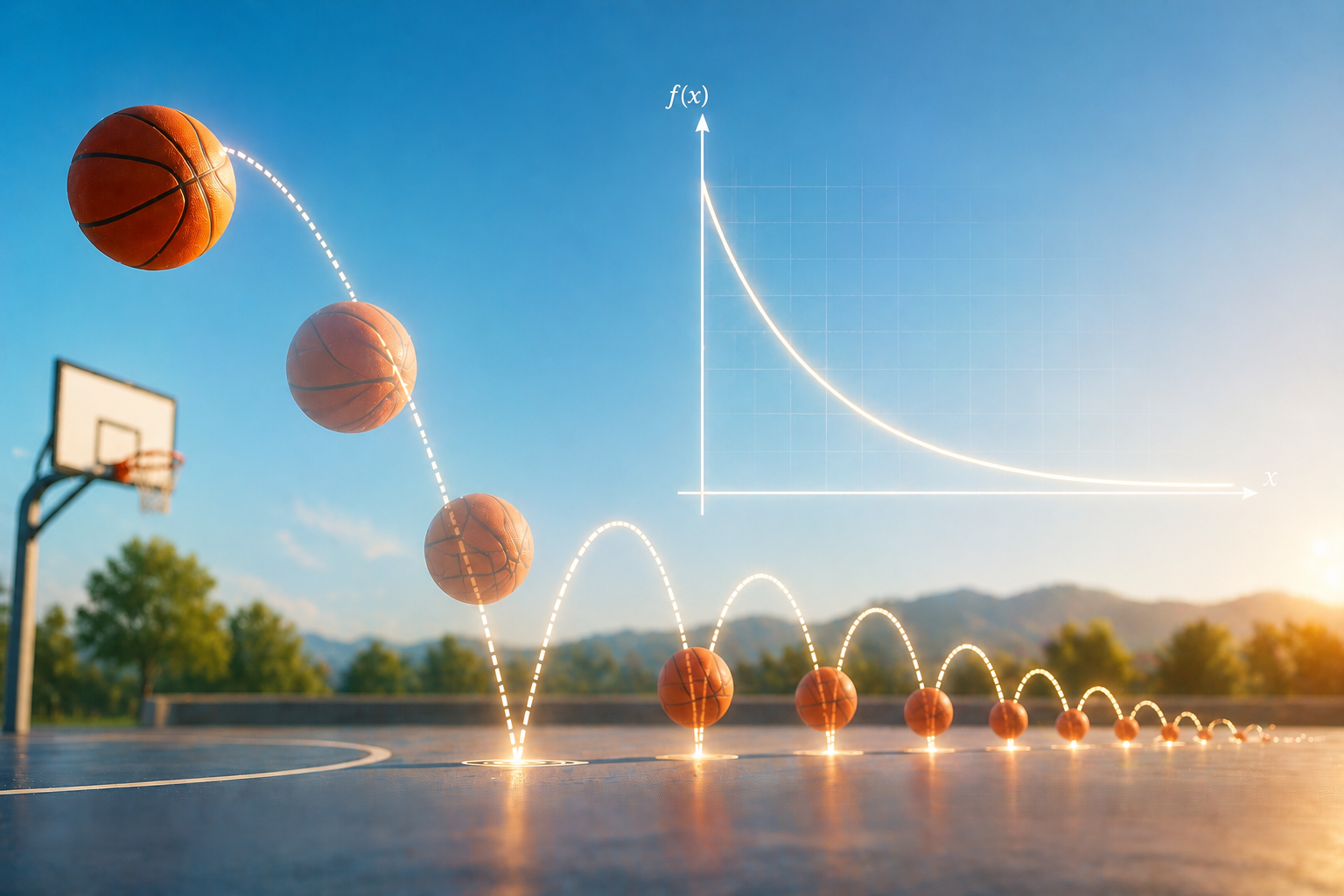
Will the ball stop bouncing? Modeling the exponential function
DOI:
https://doi.org/10.46219/rechiem.v18i1.225Keywords:
Mathematical modeling, exponential function, teaching situationAbstract
The aim of this study is to describe the modeling cycle carried out by secondary school students in a task that involved experimentation and technology for the construction of the concept of the exponential function. The methodology adopted was a qualitative descriptive approach, using an instrumental case study as the research method. A teaching situation was designed with questions aligned to the phases of the Blum–Borromeo Ferri modeling cycle, aimed at studying the phenomenon of a bouncing ball. This approach contrasts with the traditional method of teaching the exponential function, which typically follows the sequence of definition, properties, and examples. The proposal was implemented with secondary school students (aged 16–17) from a public school in Chile at the point when this content was first introduced. The results show that students can construct a model of the phenomenon and interpret it through a progression in their validation processes, supported by knowledge and reflections developed during the task. This contrasts with their initial intuitive validations and promotes meaningful learning, while also enabling them to recognize the limitations of the constructed model when making claims about the characteristics of the phenomenon in the real world.
Downloads
References
Advíncula, E. (2010). Una situación didáctica para la enseñanza de la función exponencial, dirigida a estudiantes de las carreras de humanidades [Tesis de maestría no publicada]. Pontificia Universidad Católica del Perú.
Alarcón Relmucao, N. (2024). Nociones básicas como base de la comprensión de la función exponencial en la educación secundaria: Un estudio comparativo entre Chile y Alemania [Tesis doctoral, Universidad de Bielefeld]. PUB – Publications at Bielefeld University.
Blum, W., y Borromeo Ferri, R. (2009). Mathematical modelling: Can it be taught and learnt? Journal of Mathematical Modelling and Application. 1(1), 45-58.
Borromeo Ferri, R. (2006). Theoretical and empirical differentiations of phases in the modelling process. Zentralblatt für Didaktik der Mathematik, 38(2), 86–95. https://doi.org/10.1007/BF02655883
Borromeo Ferri, R. (2010). On the influence of mathematical thinking styles on learners’ modeling behaviour. Journal für Mathematik-Didaktik, 31(1), 99–118. https://doi.org/10.1007/s13138-010-0009-8
Cambronero, S. (2002). Una construcción elemental de las funciones exponencial y logarítmica. Revista Digital: Matemática, Educación e Internet, 3(1), 1.
Colvin, R., y Edwards, V. (2018). Teaching for global competence in a rapidly changing world. OECD Publishing. https://doi.org/10.1787/9789264289024-en
Confrey, J., y Smith, E. (1995). Splitting, covariation, and their role in the development of exponential functions. Journal for Research in Mathematics Education, 26(1), 66–86.
D’Amore, B. (2008). Epistemología, didáctica de la matemática y prácticas de enseñanza. Revista de la ASOVEMAT, 17(1), 87–106.
Flores, R., y Vigo, K. (2019). La función exponencial en la enseñanza media: un estado del arte. Revista de Produção Discente em Educação Matemática, 8(2), 27-47.
González, C. (2013). Una resignificación de lo exponencial a través del binomio modelación-graficación [Tesis de maestría no publicada]. Pontificia Universidad Católica de Valparaíso.
Mayring, P. (2015). Qualitative content analysis: Theoretical background and procedures. In A. Bikner-Ahsbahs, C. Knipping, & N. Presmeg (Eds.), Approaches to qualitative research in mathematics education: Examples of methodology and methods (pp. 365–380). Springer. https://doi.org/10.1007/978-94-017-9181-6_13
Medina, V., Vallejos, M., y Gutiérrez, D. (2020). El sentido de las matemáticas. Cuaderno de Investigaciones: Semilleros Andina, 13(13), 223–231.
Ministerio de Educación de Chile. (2012). Bases curriculares 2012: Matemática. Ministerio de Educación.
Ministerio de Educación de Perú. (2016). Programa regular de educación secundaria. Ministerio de Educación.
Morales, A. (2011). Un breve estudio histórico y epistemológico de la función exponencial y análisis de algunos libros de texto. Encuentro Nacional de Educación Matemática y Estadística, 10, 123–129.
Niss, M., Blum, W., y Galbraith, P. (2007). Introduction. In W. Blum, P. L. Galbraith, H.-W. Henn y M. Niss (Eds.), Modelling and applications in mathematics education (pp. 3–32). Springer.
Pezoa, M., y Morales, A. (2016). El rol de la modelación en una situación que resignifica el concepto de función. Revista Electrónica de Investigación en Educación en Ciencias, 11(2), 52–64.
Sierra Velásquez, E. D. J. (2012). Modelación de fenómenos con respuesta exponencial [Tesis de maestría no publicada]. Universidad Nacional de Colombia.
Stake, R. E. (2007). Investigación con estudio de casos (4.ª ed.). Morata.
Sureda, P., y Otero, M. R. (2013). Estudio sobre el proceso de conceptualización de la función exponencial. Educación Matemática, 25(2), 89–118.
Vom Hofe, R. (1995). Grundvorstellungen mathematischer Inhalte. Springer Spektrum.
Yin, R. K. (2018). Case study research and applications: Design and methods (6th ed.). SAGE Publications.
Downloads
Published
How to Cite
Issue
Section
License
Copyright (c) 2026 Nicolás Gaete Silva

This work is licensed under a Creative Commons Attribution 4.0 International License.